Showing posts with label Sketch. Show all posts

Saturday, July 2, 2016

Sketches from Florence


A post of sketches from Florence would not be complete without one of the Duomo, or Cathedral Santa Maria del Fiore.
Inspiration from Stephanie Bower on this sketch of the interior of the Basilica del Santa Maria Nouvella

I loved all the beautiful archways, 

Friday, May 2, 2014

A New Path

Pullman Train Depot Project

The train depot project had several facets to the design program criteria. First was the adaptive re-use of the historical train depot, built in the late 1800's. next, was incorporating an artist's studio and gallery display space, and a 1200 sq. ft. living  space into the structure. The third criteria was to add ADA, vision impairment and universal design requirements. Finally, the program was to include my design concept, and inspiration from my artists work.


The inspiration for this design was a crack in the concrete foundation of the depot. I focused on the elements of line, texture and contrast, and through exploration I came to a final parti design.


This design was re-sized and colored in photoshop, then put into a pattern to develop my textile. I found this to be very rewarding, as receiving my fabric was the first time I have seen one of my designs come to life! I definitely improved my skills in photoshop during the textile design. I would like to continue to improve, as photoshop has so many options and things to know about the program and how to design with it.


Another part of the design process I really enjoy is concept development. The 2-dimensional parti was used to create a 3-dimensional concept model.  During this process I made several process models, until I finally came up with one worthy of making into a final model. I focused again on texture, line and contrast. I also had in mind the idea of the structural concrete form with a very organic crack in it. The idea of random versus a prescribed path came to my mind. We all have a trail through life, and wonder if it is predestined or simply random. Our paths with  cross, diverge and intersect with each other. I thought about the paths of  people that had taken the train to Pullman years ago to attend WSU. I thought of my own path, this new path of going back to school. The title of my project derived from this compilation of thoughts, and my model was titled "A New Path".
I learned through all of this that I could translate a very personal concept to include general themes. After all, we all have hard times and fears to deal with along our path.

Another step in my design process was to incorporate my concept, the research on universal design, ADA and vision impairment and blend it with my artists' work. The colors I chose came from the artwork directly. I challenged myself to use orange, a color I don't care for. Space planning was incorporated, and the design started to take shape. I began with small idea sketches,and worked on a couple of large perspectives. Details were added and changed along the way to create a harmonious design. In my gallery space, I designed every component, from the lighting, the cloud to the moveable walls and reception desk. I even designed a stream to run through the floor to incorporate my organic path. I learned that with some experimentation and design work, I could use a color I dislike to create a design I love!

Then came the final model. This was a challenge for me. The model is at 1/8" =1" scale, so it is small, and difficult to capture the details, especially when all the cutting is done by hand. Add to that the many doors and windows, the sloping eves, the parapet walls, and you have a complicated model. Oh yes, and building a roof to fit! The model was not easy, but I exercised patience, and methodical measuring. My model turned out well, and I learned that I could figure out the geometry with only minor flaws.


I also continue to learn how to solve design problems. The ADA bathrooms in the gallery area were a puzzle for me. There was enough footage for two bathrooms, but the existing windows proposed problems when trying to divide the space. My solution was to divide the space diagonally, making sure I had a 60" wheelchair turnaround, places to locate grab bars, and a t least a 36" counter for a sink. In the real world the design may not work, but at least I solved the problem in a way that met the requirements for the space.

Overall I feel I improved in several ways. First, my time management was much better, I never felt stressed or behind. I also incorporated a concept with historical preservation in a design I am proud of. I have not worked in a historical context, so this was new for me. Finally the scope of the design was larger, and on several occasions I needed to come up with solutions to design problems   I solved the problems to the best of my ability, and stretched myself to create something unlike anything I had done previously.

Monday, March 24, 2014

Portland Art Museum


I recently spent an afternoon at the Portland Art Museum. This was an absolutely wonderful way to spend an afternoon, I highly recommend taking some time to visit if you are able. I began by visiting the Ancient China Exhibit. This space had taupe colored walls, with white trim. The sculptures were enclosed in glass cases, and the lighting was spectacular, it really made the pieces come alive. The warm wood floors gave a nice haptic sense in the space. With the lighting you didn't even notice there were no windows in the room.


Ancient Chinese Horse Statue

 
The Portland Museum is very large, so after I did my wandering through the Chinese Art, I joined a group for a tour. The tour I took was  focused on experiencing the special exhibit in the museum entitled "Venice, The Golden Age of Art and Music". This tour was for the visually impaired, so since my current design project includes both a galley space and vision impairment elements, I felt this would benefit my understanding of visiting a museum with a visual impairment.
 
We began our tour in a room where a museum docent talked about the importance of music in the culture of Venice during the 16th Century. She then played a short tape, and talked about the common instruments of the time, after which a lute, recorder, and several violins were passed around for the visitors to try to play and to touch and feel. There was even a harpsichord for everyone to try!
 
After the introduction to the music of the period, we went upstairs to the gallery exhibits. We were seated in front of a large painting entitled "The Wedding Feast at Cana" by Veronese. The docent described the painting and the special features, colors and history of the painting.


After hearing about the artwork, the museum had organized a duet to play some of the period music for us. A violinist and recorder player were a wonderful addition to the time spent on this tour. I then went to experience the rest of the Venice exhibit on my own. What struck me most besides the art, was the colorful walls. Red, blue, green and gold were colors painted upon the permanent and moveable museum walls. The unifying factor was the white wainscoting and millwork. The wall colors really helped to "pull" you through the spaces. Here are a couple of examples of how they used color.


Lighting was all artificial in this exhibit, they used adjustable track lights, but not the type I usually see. These were recessed tracks in the coffered ceilings which the curators used to direct light onto the art pieces. There was also plenty of ambient lighting, which made the spaces bright and cheerful with all the color.


Thursday, December 12, 2013

Reflection


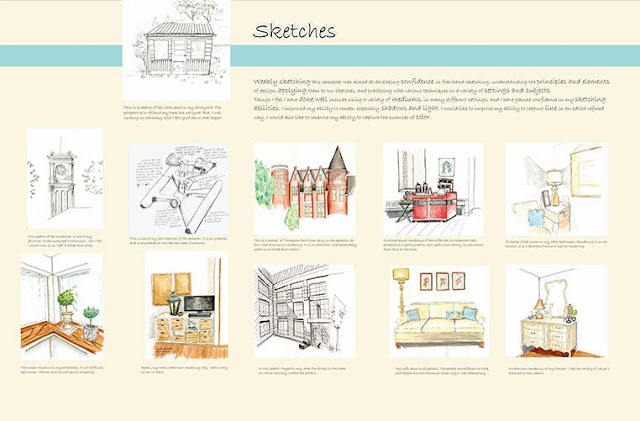
Line, all sketches begin with line. It is such an important element when communicating a
design or idea. The first way I have progressed in being able to communicate visually, is by improving the quality if line in my sketches. One important lesson I have learned is that less is more, and to make every line gesture count toward the overall sketch composition. It is a very effective way of visual communication to use fewer lines. Line weight is another important aspect to sketching. As with all design, a good sketch or drawing should have an n established hierarchy of line. This communicates the importance of features, as well as emphasizing the principles of rhythm, repetition and contrast. The element of line is something I will continue to focus on, and hopefully make more progress on as I continue to learn and improve my freehand and drafted drawings.


    A second way I have progressed in my ability to communicate visually is by experimenting with different styles of drawing. I have especially worked on communicating through a “looser” style. The sketches and drawings I find most appealing have both a controlled aspect and a “loose” aspect. I am at ease with the control, but have been working toward a freer style. I have tried several ways to develop this style. One, I have held my pencil, or drawing tool in a free, loose way, having a grip at the end of the utensil away from the paper. I have also experimented with different types of media to help develop a less constricted way of sketching.

     Use of media is also something I have worked on and developed this semester. I have used several types of media that I have never used before, including oil pastels and xylene based markers. I have also continued to refine my use of watercolor and colored pencil. Another approach I have tried is to mix different types of media within one sketch or drawing. The most successful being the use of colored pencil and marker together. I will continue to try different types of media and mixing them in new and different ways to create unusual effects that can further enhance my drawings. I believe this will enhance what I have learned this far, and help me to grow and learn in my ability to communicate visually.
     Finally, and probably most importantly, I have gained confidence in my abilities this semester. As my drawing and sketching abilities have improved I have become more confident. I have challenged myself to try new things and create more difficult sketches all semester. I will continue to push myself, so I can be comfortable in my ability to render, sketch and draw.
 

Saturday, October 5, 2013

Job Shadow

   While in Seattle, I was so fortunate to spend a day at the Gensler firm located on Sixth Avenue in downtown Seattle. It was an absolutely wonderful experience, and I would not change one thing about the entire day.
   The morning began with meeting Chelsea, a LEED certified designer in the firm.  She started with a tour of their office space. It is a beautiful space, and I am sure that clients are as comfortable as I was when I visited.  Chelsea was relaxed and friendly, and immediately I felt at ease. She showed the break-out rooms for small meetings, the living room that was used for meetings, or when the people working need a little more relaxed space could work. I toured the design library space, the kitchen, and the working spaces. Chelsea pointed out some of the projects, and models that people in the office were currently working on. A hotel project in Tahiti immediately caught my eye.
   After the tour, Chelsea took out the materials from the project she was working on. It included all the materials, as the project was ready for a client presentation that afternoon. I saw the plans, elevations, color schemes, and materials she had chosen to show the clients. It all was very inspiring, and I could definitely see myself doing this type of work.
   After Chelsea, I met with Jennifer. She is a Test Planner in the Gensler office. She showed us the project she was working on, and how she takes the program from the client, and tries different spaces to see if all the needs can be met within the space. She does this through bubble diagrams, and trace overlays. It was so educational to see her approach, and something I will take from for a long time.
   Jennifer passed me along to Kara. She took me to a project they had recently finished that she had been working on. It was so exciting to see the space, and hear about Kara’s job at Gensler. Kara is a design coordinator, which basically means that she is the one that plans all the components of a project, and makes sure they are all in sync.  She took us to the Glumac office space there in downtown. I t was such fun to see a completed project! I learned a lot about details, and things I hadn’t even thought about while I was with Kara. She definitely opened my eyes to job possibilities that I did not know about in the design world. Kara took me to the Seattle Convention Center for a wonderful, healthy lunch, and then we headed back to the Gensler office.
   Once we were back in the office, we saw a presentation from a furniture design company from London. It was a good experience, as I had never sat in on a presentation of this type. Their aesthetic was very clean and modern, and they had many good features to their designs. I especially appreciated the green aspect to their designs.
   Finally, I met with Stephanie de Villa and Savannah Barker. Stephanie is working on a project with Princess Cruise Lines, and talked a little about that. But what was really interesting to hear from these two, is how they go about getting new job opportunities in a sector of business they don’t currently have a large market share in. I heard how the developed a focus group, and things they did to try to obtain business in the restaurant and boutique sector. I am sure they will be successful at this, as they were both talented resourceful women.
I really could not have had a better Job Shadow experience. It was an inspiring day filled with inspiring people. I hope to be part of this exciting design world soon!

Frye Art Museum


   During my day of touring around Seattle, I visited the Frye Art Museum. It is also located on Capitol Hill in Seattle. From the outside, the museum look rather ordinary, but once you reach the entrance, is when you see the beautiful architecture begin.
   The entrance is a series of arches, or an archade, made of bare concrete. The simplicity of the material fits perfectly with the honest straightforward design. Rick Sundberg, the architect that did the design, was there and talked about how he wanted the entrance to be an experience. His vision was to prepare visitors to see the art in the museum. He spoke of how we all come to buildings equally, and how the arches were set up in a sequence with the water pool to create a sense of calm before entering the structure.

   Inside, the rotunda is the star of the building. It has a domed ceiling that is a perfect sphere. The rotunda, the sphere, and the entire building are based on the golden section. Even the pavers are based on this geometric theme.  Mr. Sundberg also talked of the buildings theme on light, and how it is used to move people through the space. The light enters through windows a s well as shafts that stream light into the space. It was definitely am inspiring space, with many great ways of playing with light in an interior space.

Sketch Crawl

Saturday morning, I got up, grabbed some coffee, and was headed to Seattle Center. I was going on a sketch-crawl! It was a meet-up of sorts with the local Urban Sketchers group. Now, I wasn’t quite sure what to expect. Were we going to crawl or lie on the ground to sketch? Would we all sketch the same thing?
   It turns out neither of those things happened. I met them in the Seattle Center food court, got acquainted and saw some of their amazing, inspiring work, and headed out to sketch, with a plan of getting back together after an hour.
   First, I will tell you a bit about the Urban Sketchers organization. They are a group that meets about once a month to sketch. They feel strongly that there is an educational, storytelling aspect to location drawing. Their aim is to tell a story of their surroundings and to record the time and place. Urban Sketchers have a network of blogs, and a Flickr group to share their work with others.

   I choose for my sketch to do the newly installed “sonic bloom”. Sonic Bloom is a motion-activated set of giant flowers that create noise when there is motion nearby. The set of five flowers are solar-powered, and they bask colored light over the Seattle center at night. While I was there in the daylight, it was still a fun and unusual thing to sketch.

The Chapel of Saint Ignatius

   The Chapel of Saint Ignatuis is located on the top of Seattle’s Capitol Hill area, on the campus of Seattle University.  It is the main chapel on the Catholic University’s campus. I was there to study and enjoy the creation by architect Steven Holl. He based his design on the Catholic worship story of “seven bottles in a stone box”. Light passes through various colored glass windows into each “bottle”, defining each space through light and color. It is not difficult to see, and even feel the building’s theme of bringing light to life. It is so masterfully done, with direct light, reflected light, indirect light, shade and shadow.
   The interior walls are almost entirely made of white plaster, tooled with a 12” serrated trowel. Even this most basic material is brought to life through the light. The designers of this space felt this white light was a metaphor for the collective students at Seattle University coming together.
   There were many aspects of this building that caught my attention. First, the door and its beautiful bronze handle. Architect Jim Graham spoke of the handle as being “the handshake of the building” It is the feature most often touched by anyone who enters, and may be the only thing they touch. It is therefore important that the handle be beautiful and comfortable to touch.


   A second detail that caught my eye, were the bronze pieces on the building exterior. I took time to sketch one, but could not figure out what their purpose might be. Mr. Graham was kind enough to explain them, and the story was fascinating. He told how the concrete walls were poured into slabs, but they wanted the top of the slab to face the building’s exterior, which is not the norm. For this reason, they needed to place metal hooks into the concrete, so they could hoist the slabs into their vertical position. Instead of just using rebar, or something just totally utilitarian, they made the pieces part of the design. The pieces are cast bronze, sculpted from a cast of an old Japanese fishing float. One can even see the wood grain from the float in the bronze. It was very inspiring to see beauty and function working together in harmony. That is how I felt about the entire space, beauty, function and inspiration all working together. Exactly what a Chapel or Church should be.

Friday, July 26, 2013

Morrill Hall

A 2 point exterior sketch I did of Morrill Hall. Again, this is on the campus of WSU. I would like to improve my skills in this type of sketch, as this one is a little bit skewed. I am improving my skills in sketching trees and bushes, so I know I will improve in these perspective sketches too. The thing I do like about this sketch is the use of value achieved in the graphite.

2 Point Perspective

This is my first 2 point perspective. I did a corner in my little apartment. While I like the range of value I achieved in this sketch, I wish I would have used a little more white. These windows are one of the reasons I rented this space, I just adore all the light they bring into my tiny place!

College Hall Sketch

This is College Hall on the campus of WSU. I love the buildings on this campus, many of them are this old style of architecture, and have such great detail.It makes for a challenging perspective sketch, but it is a fun challenge for me. I see in this work that I would like to improve upon my sketching of plant materials, and the perspective is a little off. I guess i need to pay more attention to these things while I am sketching.

A Favorite Way to Sketch

Take a nice warm summer evening, or afternoon, add a glass of wine, a good friend, and a sketch, and you have my recipe for a very enjoyable time! For this sketch, I did one study in graphite, and another in ink using a hatching technique for the shading. Combining the elements of shading and perspective drawing proved to be easier than i thought it might be, maybe it was the wine!

Stairs- Shade and Shadow

Studying the shade and and shadow that the stair railing makes on the concrete is a nice way to spend a summer afternoon in my book. I enjoyed this sketch, and learned how to look at shade and shadows that structures cast in a whole new way.

Leaves


I like this little sketch of negative space around a group of leaves. I darkened the edges of the forms around the leaves so the spaces would not seem so flat. I also shaded the area in a flowing pattern to give the background some movement. I feel it is important to see the shapes that the negative space makes, it can be so interesting.

Fruit Watercolor

For this sketch, I started with a little value sketch of a fruit grouping. Luckily I love fruit, and had plenty to choose from on hand! After my initial sketch, I took a piece of watercolor paper, and did the same grouping in watercolor. The background seemed very flat and white, so I added a little color wash to liven up the composition. I like how this piece turned out, a little bit controlled, and a little bit free flowing. I enjoy doing these types of studies, and hope to do more in the future.

Napkin Sketch

Here is a small sketch I did on a napkin. No measurements were used, just tried to "eyeball" it.  I also had trouble with the perspective and horizon line. But I like to do small quick sketches that are informal, as this one is.


Chair Study

For this sketch I drew and dimensioned a chair in my place.  While it is not perfect ( the seat should be flat on the side and back view), I am happy with the dimensioning. I feel it is a good representation of the chair, and fairly accurately shows the size and scale.

Wednesday, July 10, 2013

Concept Design in 2 Dimensions

As concept design began, I  found an object that in some way that had elements of design from the Baroque Period of Design. I chose a shell because of the curved lines and the domed shape of the cap.Then I proceeded to realistic drawings of my "found" object, which I did in graphite. I enjoyed doing these sketches, and felt that they were good representations of the shell that I began with. I always feel comfortable using graphite and thought that the shading and detail of the sketches was good.
The next step in my design process was to do thumbnail sketches to abstract the realistic images. I was purely looking at the elements and principles of design. Things that came to my mind, were radial symmetry, texture,curved line,rhythm and form, among others. While I enjoyed the abstractions, and have learned so much from doing them,  now I look back, and see other directions that I might have explored.

Monday, July 1, 2013

Palouse Sketch


This is my first effort with the Wacom tablet, a computerized drawing tool. While I am definitely not proficient with this tool, I enjoyed using it and I am pleased with my result. I am hoping as time goes on, and I have more practice, I will feel more comfortable with this form of media. I like the line created, but did not realize that the line was not complete on the right horizon, and would  like that line to come to the edge of the picture. I am proud of  the painterly effect I created in this work,a skill I would like to build upon.